Menu
cardinal
In Stock

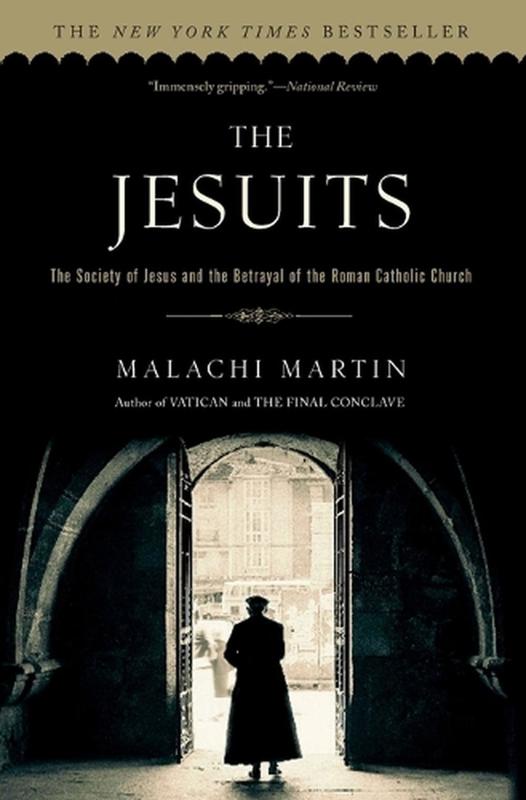
Jesuits by Malachi Martin (English) Paperback Book

(22)
£22.99 £22.99
SKU: 87245266
Vendor: Simon & Schuster
SiteId Sku UnitPrice Link
48585 87245266 22.99 More Info
Message
Guaranteed safe checkout:
The Nile on eBay
  FREE SHIPPING UK WIDE
 

Jesuits

by Malachi Martin

Synopsis coming soon.......

FORMAT
Paperback
LANGUAGE
English
CONDITION
Brand New


Publisher Description

In The Jesuits, Malachi Martin reveals for the first time the harrowing behind-the-scenes story of the "new" worldwide Society of Jesus. The leaders and the dupes; the blood and the pathos; the politics, the betrayals and the humiliations; the unheard-of alliances and compromises. The Jesuits tells a true story of today that is already changing the face of all our tomorrows.

Author Biography

Malachi Martin is an eminent theologian, expert on the Catholic Church, and former Jesuit and professor at the Vatican's Pontifical Biblical Institute. He is the author of the national best-sellers Vatican, The Final Conclave, and Hostage to the Devil.

Long Description

InThe Jesuits,Malachi Martin reveals for the first time the harrowing behind-the-scenes story of the "new" worldwide Society of Jesus. The leaders and the dupes; the blood and the pathos; the politics, the betrayals and the humiliations; the unheard-of alliances and compromises.The Jesuitstells a true story of today that is already changing the face of all our tomorrows.

Excerpt from Book

Chapter 1 PAPAL OBJECTIONS Every Pope worth his salt sets a dominant strategy for his papacy. He formulates many policies, pursues various particular aims: but all policies and each single aim are framed within the scope of that strategy. The Society of Jesus was established by the papacy in 1540 as a very special "fighting unit" at the total and exclusive disposal of the Roman Pope -- whoever he might be. From their beginnings, the Jesuits were conceived in a military mode. Soldiers of Christ, they were given only two purposes: to propagate the religious doctrine and the moral law of the Roman Catholic Church as proposed and taught by the Roman Pope, and to defend the rights and prerogatives of that same Roman Pope. Purely spiritual and supernatural purposes. And specifically Roman Catholic. Surprisingly enough, given this mandate of the Society, papal strategy itself has become the wedge of separation between Jesuits and papacy -- indeed, the very arena where the lethal battle between the two is being fought. Plus XII, Pope from 1939 to 1958, had found himself in a new world dominated by two rival superpowers, one of which -- the USSR -- he held in anathema. His postwar policy was one of intractable opposition to Soviet Marxism, and of support for "Western" civilization, centered in Europe and protected by the United States. John XXIII, Pope from 1958 to 1963, was convinced that an "open windows, open fields" policy would induce others -- including the Soviets -- to refashion their own attitudes and policies. Pope John lowered as many barriers between the Church and the world -- including the Soviet Union -- as he could in his short, action-packed pontificate. He even went so far as to guarantee the USSR immunity from attacks by the Church, a stunning reversal of papal attitudes. It was a huge gamble. And it could only work if an adequate amount of goodwill reigned among his opposite numbers. The gamble failed. The great poignancy was that when he died, Pope John, peasant-realist that he was, knew that his openness had been seen as weakness, and had been taken advantage of by men of much smaller spirit. Pope Paul VI, 1963-1978, blind to the deficiencies of John''s policy, further refined it. The Holy See became nothing less than a plaintiff at the bar of Soviet power, pleading on diplomatic grounds for a hearing; instituting cautious conversations; practicing the week-kneed art of concessionary approaches -- and even stooping to mean-spirited deception and betrayal of the admittedly difficult Primate of Hungary, Cardinal Mindszenty, in order to please the Soviets and their castrated Hungarian surrogate, Janos Kadar. In all of this, Paul VI, personally the gentlest of all modern Popes, unwittingly compromised his papal authority. His grand strategy for his Church was taken over and prostituted by others, reducing him to an impotence that scarred his last disease-ridden years until his death on August 6, 1978. Still, it was Paul VI who, very late in the day of his papacy, realized that the original dual purpose of the Society of Jesus had been changed. Under his pontificate, an extensive critical dossier about the Society was compiled. It is enough for the moment to say of that dossier that its contents were damning. It was a portrait, in effect, of a Jesuit Order that, like a weathervane atop a roof, had been turned by a different wind. For Jesuits, the papacy no longer held primacy of position. The corporate aim of the Society was now to place itself and the Church at the disposal of a radical and purely sociopolitical change in the world, without reference to -- indeed, in defiance of -- papal strategy, policies, and aims. In 1973, Paul VI, alarmed more than ever by the way the Society''s members were behaving, tried to stop the onrush of events. He met with the head of the Order, Jesuit Father General Pedro Arrupe, several times. More than a few of those interviews between the two men were stormy. More than once, Paul wanted Arrupe to resign. One way or the other, Arrupe survived all papal attacks. Paul VI did insist that Arrupe convey to his Jesuits "Our demand that the Jesuits remain loyal to the Pope." Arrupe and his assistants in Rome at that time were intent on preparing for another international assembly of the Order, a General Congregation, as such an assembly is called. So he bought time, valuable time. Paul, in his weakness, could find no alternative but to wait. Paul did make one last but equally ineffective attempt to recall the allegiance of the Society to the papacy during the ninety-six-day international assembly of Jesuit leaders, the 32nd General Congregation of 1974-1975. His effort met with total incomprehension and stubborn -- some said even self-righteous -- opposition from the Order. Pope and Jesuits simply could not agree. The Jesuits would not obey. Paul was too weak to force the issue farther. "When you have people [the Jesuits]," wrote Jesuit Father M. Buckley about Paul''s attitude to that 32nd General Congregation, "who do not think they have made errors either in content or procedure, and when they are suspected, resisted or reproved by the very man they are attempting to serve...you have...a very serious religious problem." To say the least. Cardinal Albino Luciani of Venice was elected to succeed Paul VI on August 26, 1978. Even before he became Pope, he had apparently made up his mind unfavorably about the Society. And apparently the Society had already made up its mind about Pope John Paul I. No sooner had he been elected than the Jesuits asserted themselves. Father Vincent O''Keefe, the most prominent of the four General Assistants to Arrupe, and the one being groomed to succeed Arrupe one day as Father General of the Order, told a Dutch newspaper in an interview that the new Pope should reconsider the Church''s ban on abortion, homosexuality, and priesthood for women. The interview was published. Pope John Paul I was incensed. This was more than contempt. It was an assertion that the Society of Jesus knew better than the Pope what morals Catholics should practice. And it was an assertion that the Society had the authority to speak out; that is, it was a direct appropriation of the authority that belonged exclusively to the papacy. John Paul I summoned Arrupe and demanded an explanation. Arrupe humbly promised to look into the whole matter. But John Paul could read the handwriting on the wall as clearly as any Pope. On the basis of Paul VI''s critical dossier, and with the help of a very experienced old Jesuit, Father Paolo Dezza, who had been Confessor to Pope Paul VI and now was John Paul I''s confessor, the Pope composed a hard-hitting speech of warning. He planned to deliver it to the international assembly of Jesuit leaders and Father General Arrupe at another of their General Congregations to be held in Rome on September 30, 1978. One of the striking features of his speech was John Paul I''s repeated reference to doctrinal deviations on the part of Jesuits. "Let it not happen that the teachings and publications of Jesuits contain anything to cause confusion among the faithful." Doctrinal deviation was for him the most ominous symptom of Jesuit failure. Veiled beneath the polished veneer of its graceful romanit
Details

ISBN067165716X
Author Malachi Martin
Short Title JESUITS
Publisher Simon & Schuster
Language English
ISBN-10 067165716X
ISBN-13 9780671657161
Media Book
Format Paperback
DEWEY 271.53
Year 1988
Place of Publication New York
Country of Publication United States
Imprint Simon & Schuster
DOI 10.1604/9780671657161
NZ Release Date 1988-02-15
US Release Date 1988-02-15
UK Release Date 1988-02-15
AU Release Date 1988-04-30
Pages 528
Publication Date 1988-02-15
Audience General

TheNile_Item_ID:102289421;
img